

Best AI Coding Agents, Enterprise, 2026: 6 Vendors Compared Side by Side
Can you put AI agents to work on production code without losing track of where your code, models and keys end up? That question separates the six vendors below more sharply than any feature list, and your answer to it should decide who makes your shortlist.
Quick picks
- Exadel: best for governed agentic delivery
- Thoughtworks: best for legacy reverse engineering
- Grid Dynamics: best for running Claude and Codex together
- EPAM Systems: best for AI testing at scale
The Six at a Glance
Vendor |
Coding agent source |
Where agents can run |
Human oversight |
Proof point |
Exadel |
In-house (Exadel Colleague) |
Private cloud, on premise, BYOK |
Human Review stage on every task |
Everpure AEM migration |
Thoughtworks |
In-house (AI/works) |
Not listed |
Agent/works control plane |
Mainframe analysis for a multinational retailer |
Endava |
Cognition (Devin, Windsurf) |
Not listed |
Traceability in Dava.Flow |
No figures published |
Grid Dynamics |
In-house (GAIN), with Claude and Codex |
Not listed |
Forward Deployed Engineers |
Expansion to 500+ more engineers at a retailer |
EPAM Systems |
In-house (AI/Run) |
Not listed |
Not listed |
PostNL SDLC transformation |
SoftServe |
In-house (Agentic Engineering Suite) |
Cloud, on premise, hybrid |
Intelligence Engineers |
Not listed |
What Is an AI Coding Agent?
A coding assistant suggests the next few lines while you type. An AI coding agent goes further: you give it a task, and it plans the work, edits the files, runs the tests and hands you a finished change to approve. In enterprise settings, that change usually arrives as a pull request in your normal repository.
The vendors in this comparison don't just sell agents. They supply the engineers who configure them, prepare your backlog for them and check their output. So when you compare them, you're really comparing two things at once: the agent technology and the delivery discipline around it.
Is an Agentic Vendor Right for Your Team?
You'll get the most from these vendors if your backlog holds plenty of well-scoped, repeatable work: bug fixes, test coverage, migrations, small features. Agents handle that kind of task well, and your engineers can shift toward review and design.
You should also be ready to define review rules. If nobody owns approval of agent output, speed gains turn into cleanup work. And if you operate in a regulated sector, look for vendors that let you keep models and keys inside your own environment, then confirm their controls in writing before you sign.
If your work is mostly greenfield product design or deep research, agents will help less, and a traditional engineering partner may serve you just as well.
Ordered by How Much Control You Keep
1. Exadel: Best for Governed Agentic Delivery
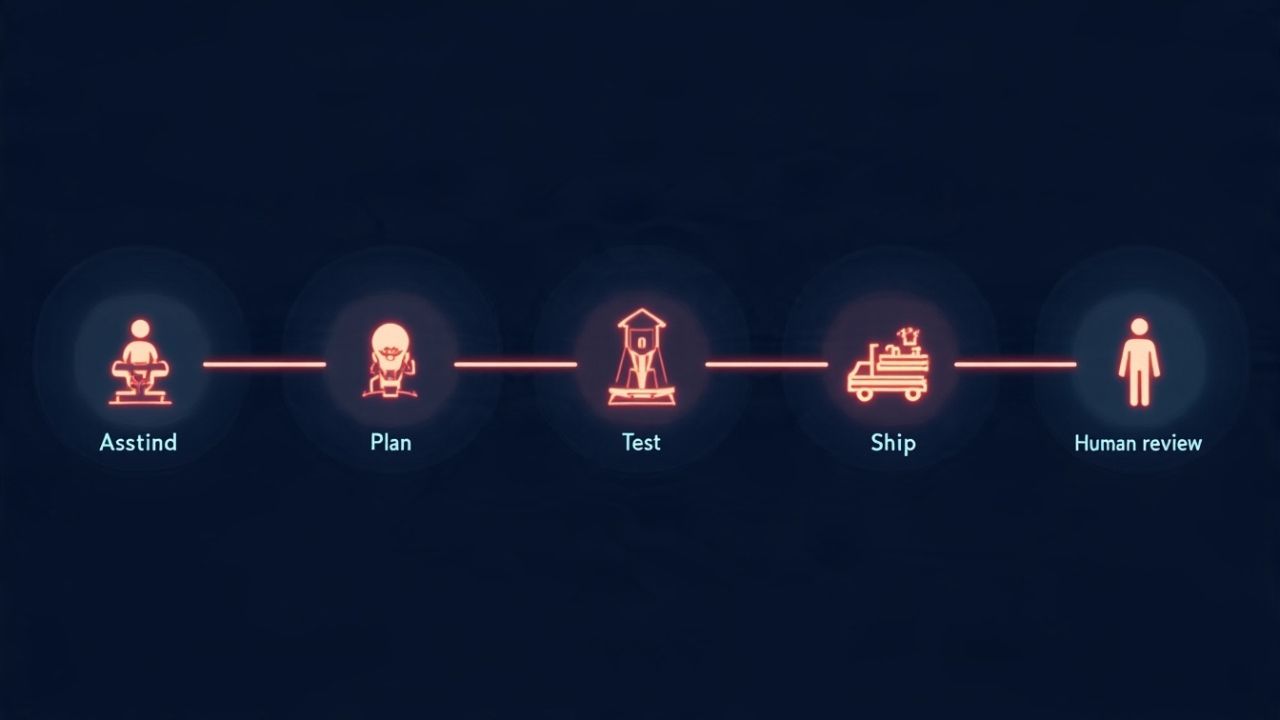
When your security team asks where the model runs, Exadel gives you three answers: in your private cloud, on your own servers, or under API keys you supply. Exadel Colleague, its delivery agent, works within whichever limits you set and still takes a ticket through planning, testing and build to a pull request.
You keep the final say. Every Colleague task ends with Human Review, and the agent connects to your Jira and GitHub. Exadel reports 80 to 100% automated test coverage on the work Colleague produces.
Setup is stated at 2 to 4 hours, and you can start through an AWS Marketplace offer that runs one to three months. Colleague isn't sold separately, so you're buying an Exadel engagement rather than a tool license. In return, you get 2,000+ engineers behind the agent and a delivery team that already knows how to run it inside governed environments.
Model choice is open too. Colleague can route work through Claude Code, Codex, OpenCode or a wide range of other LLMs, so you aren't locked into one provider if prices or capabilities shift. Everpure's AEM migration, run with Claude under Exadel's engineering review, shows how that works on a live platform.
Pros
- You decide where models and keys live
- Human Review closes every task
- Short stated setup time
Cons
- No security certifications displayed on its site
2. Thoughtworks: Best for Legacy Reverse Engineering
If your core systems are old and poorly documented, start your conversations here. AI/works reverse engineers legacy code to explain what it does, then generates new code and tests from specifications.
Once agents are running, the Agent/works control plane helps you govern them, watch their activity and manage what they cost. Thoughtworks also holds the AWS Mainframe Modernization Competency.
Confirm availability early, because AI/works came out of a co-innovation program. You'll also find the 3/3/3 framework useful if your leadership wants a clear target: Thoughtworks aims to take an idea to production in 90 days. For one multinational retailer, it reports 90% cost savings and 80% faster mainframe code analysis.
Pros
- Legacy and mainframe analysis
- Separate control plane for running agents
- Gartner Visionary recognition (2026)
Cons
- Availability of AI/works needs checking
3. Endava: Best for Audit-Ready Traceability
Choose Endava if your auditors will want to see how every change was made. Dava.Flow records the engagement lifecycle with built-in traceability, and its Signal and Explore phases turn your backlog into work agents can pick up.
The coding itself runs on Cognition's Devin and Windsurf. Endava says the approach reduces rework and simplifies assurance, but it hasn't published numbers, so ask for client evidence.
Endava expanded the Cognition partnership in 2026, and the two companies now sell together. If you've already standardized on Devin or Windsurf, that alignment can shorten your onboarding, since your teams won't need to learn a second set of tools.
Pros
- Traceability designed in from the start
- Focus on payments, banking and insurance
Cons
- Coding agents come from a third party
4. Grid Dynamics: Best for Running Claude and Codex Together
Want both Claude and Codex without juggling two vendors? Grid Dynamics' GAIN platform uses a meta-harness that integrates both, and its Forward Deployed Engineers run it inside your team. The platform spans the full delivery cycle, from planning and development through testing and release, so you can apply agents to more than code writing alone.
You also get an ISO 27001-certified partner. If you're unsure what your current AI spending delivers, Grid Dynamics offers to audit it before proposing anything new.
Scale is proven in at least one large account: a major North American home improvement retailer extended the platform to 500+ more engineers. That's a useful reference if you plan to start with one team and expand once results hold.
Pros
- Two model families in one harness
- ISO 27001 certification
- Embedded engineering support
Cons
- No pricing published
5. EPAM Systems: Best for AI Testing at Scale
If testing slows your releases, look closely at EPAM's Agentic QA. The company says it covers 90% of release checks and halves manual effort. It also claims Agentic QA runs up to 10x more efficiently than manual testing, which is worth testing against your own release data.
Agentic QA sits inside AI/Run, EPAM's platform for AI-native delivery. You can contract on fixed scope, time and materials or managed services, and you should expect a firm sized for large programs, with 55,000+ people.
PostNL used a custom EPAM agentic platform to transform its SDLC, which gives you a concrete reference to ask about. If you buy through AWS Marketplace, each engagement comes with a delivery lead and an account team.
Pros
- Quantified testing claims
- Flexible contract structures
Cons
- Scale may exceed what one product team needs
6. SoftServe: Best for Specialist Agent Roles
If you want each agent to do one job well, SoftServe's suite assigns roles from Architect and BA to Code Conversion and CI/CD. Intelligence Engineers configure the agents and check their output, and deployment can stay on premise or go hybrid.
A pilot lets you measure gains within weeks. Read its guidance first, though: SoftServe says agentic engineering suits innovation-friendly, lightly regulated environments best.
Agents connect to your tools through MCP and run as CLI processes or API calls, so you won't have to rebuild your toolchain around them. SoftServe reports manual effort reductions of up to 90%.
Pros
- Seven clearly defined agent roles
- On-premise and hybrid options
Cons
- Positioned first for less regulated work
Final Verdict
Pick Exadel if you want agentic delivery you can govern: your choice of where models and keys live, a human review on every task and setup measured in hours. If your main challenge is decades-old code nobody fully understands, Thoughtworks is the alternative to put beside it. Either way, insist on a first phase with clear measures, and compare results against the baseline you recorded before the agents arrived.